Tech
One Simulator, Three Cars: How Cockpit Configuration Changes Across Categories
The principles of cockpit fidelity in professional simulation are well established. A driver's perception of the car is shaped by seating position, visibility, pedal feel and steering geometry. Any deviation from the real car introduces adaptation, and adaptation introduces noise into the engineering process.
What receives less attention is how those principles are applied in practice — and how significantly that application changes depending on the category of car being simulated.
Single-seaters, GT cars and LMP prototypes each present a different set of engineering requirements. The chassis architecture differs. The control systems differ. The driver aids differ. The cockpit ergonomics differ. Building a simulator that genuinely serves a professional programme in any of these categories means understanding those differences in depth and configuring the simulator accordingly.
This article outlines how we approach that challenge at Virtex, and why a generic solution is rarely adequate.
The cockpit as part of the system
Before looking at specific categories, it is worth establishing the underlying principle. The cockpit is not a physical enclosure surrounding a simulator. It is the interface through which the driver interacts with the vehicle model.
A racing driver does not experience the car in abstraction. They experience it through a seating position, a set of reference points, a steering wheel, a brake pedal, a throttle. Those elements shape how they perceive lateral and longitudinal forces, how they modulate braking, and how they interpret balance changes. Move any of them, and the driver's behaviour changes — even if the vehicle model remains identical.
For a simulator to support genuine engineering work, the driver must be operating in the same physical reference frame as they would in the real car. That requirement sounds straightforward. In practice, meeting it across different car categories demands a different approach for each one.

Single-seaters: standardisation as an advantage
Formula categories such as F2 and F3 present a relatively well-defined cockpit challenge. The chassis is standardised across the series — the same geometry, the same pedal travel, the same steering wheel configuration. Setup changes are the primary variable between cars, not the fundamental ergonomic architecture.
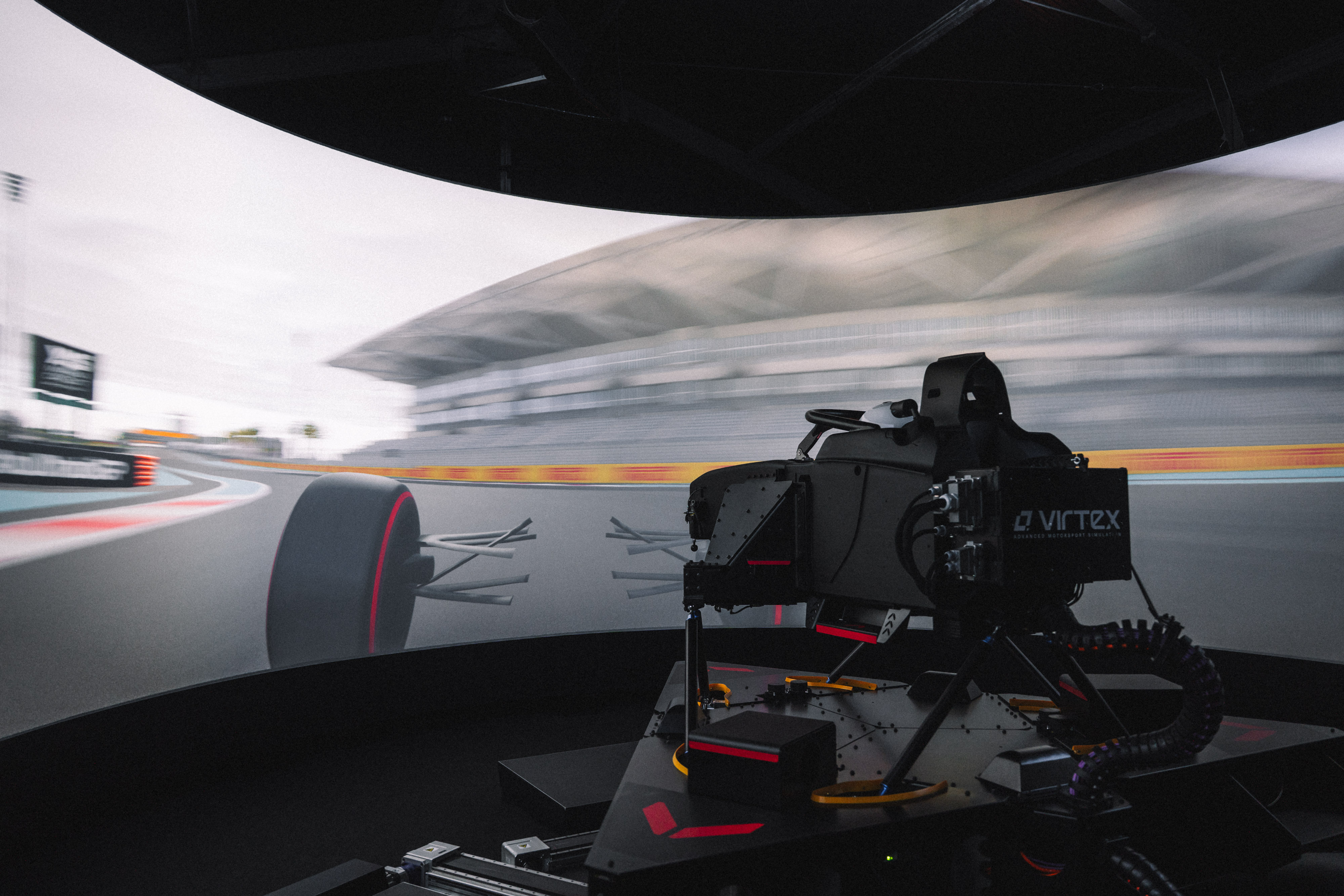
At Virtex, our single-seater simulator is built around a real F2 chassis, fitted with the original steering wheel, controls, brake and throttle pedals. This is not simply a question of aesthetics. Placing the driver in the actual monocoque, with the correct seating position and control geometry, eliminates the adaptation layer entirely. The muscle memory the driver develops in the simulator is the same muscle memory they will rely on at the circuit.
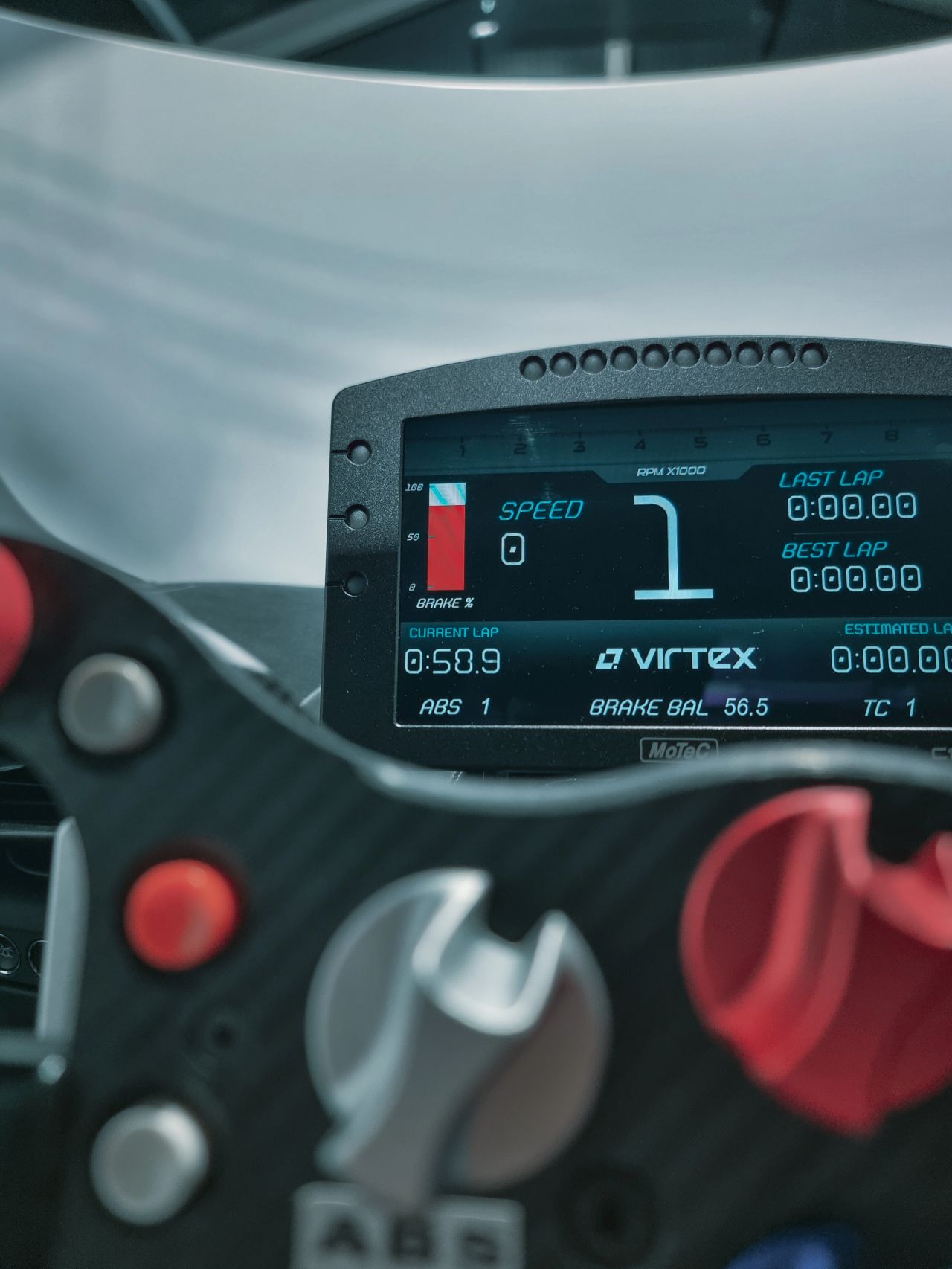
This matters particularly for drivers who are new to a series. In Formula categories, the steering wheel carries a significant number of controls: brake bias adjustment, DRS actuation, multi-function rotary switches, pit lane limiters, warning systems. A driver unfamiliar with the layout will initially divide attention between managing these systems and managing the car itself. Simulator time with the real controls allows that process to become automatic before they arrive at a circuit.
We have seen this directly with F2 and F3 drivers. Several arrived at the simulator struggling with brake bias adjustments under braking — a task that requires precise manual input at a moment of high cognitive load. Regular practice with the real cockpit allowed them to automate those adjustments, freeing attention for the broader driving task.
The vehicle model for single-seater programmes includes full ECU emulation and telemetry output structured to match what the team will analyse at the circuit. Setup changes in the simulator — spring rates, damper settings, aerodynamic balance — produce responses that correlate with on-track behaviour. The graphics model is matched to the relevant series, with F1 configuration available where required.
GT cars: managing variation across brands
GT programmes present a substantially more complex cockpit challenge. Unlike Formula categories, the GT3 and GT4 fields are populated by a wide variety of manufacturers, each with distinct ergonomic configurations. Brake pedal travel varies. Pedal stiffness varies considerably from one brand to another. Seating positions differ. Steering wheel layouts and display systems are brand-specific.
A simulator configured for a Porsche programme cannot simply be handed to a driver preparing for a Ferrari or a McLaren without meaningful reconfiguration. The differences in pedal feel alone are sufficient to alter braking technique. If a driver arrives at the circuit having practised in an environment with mismatched pedal characteristics, the early laps will involve re-calibration rather than performance.
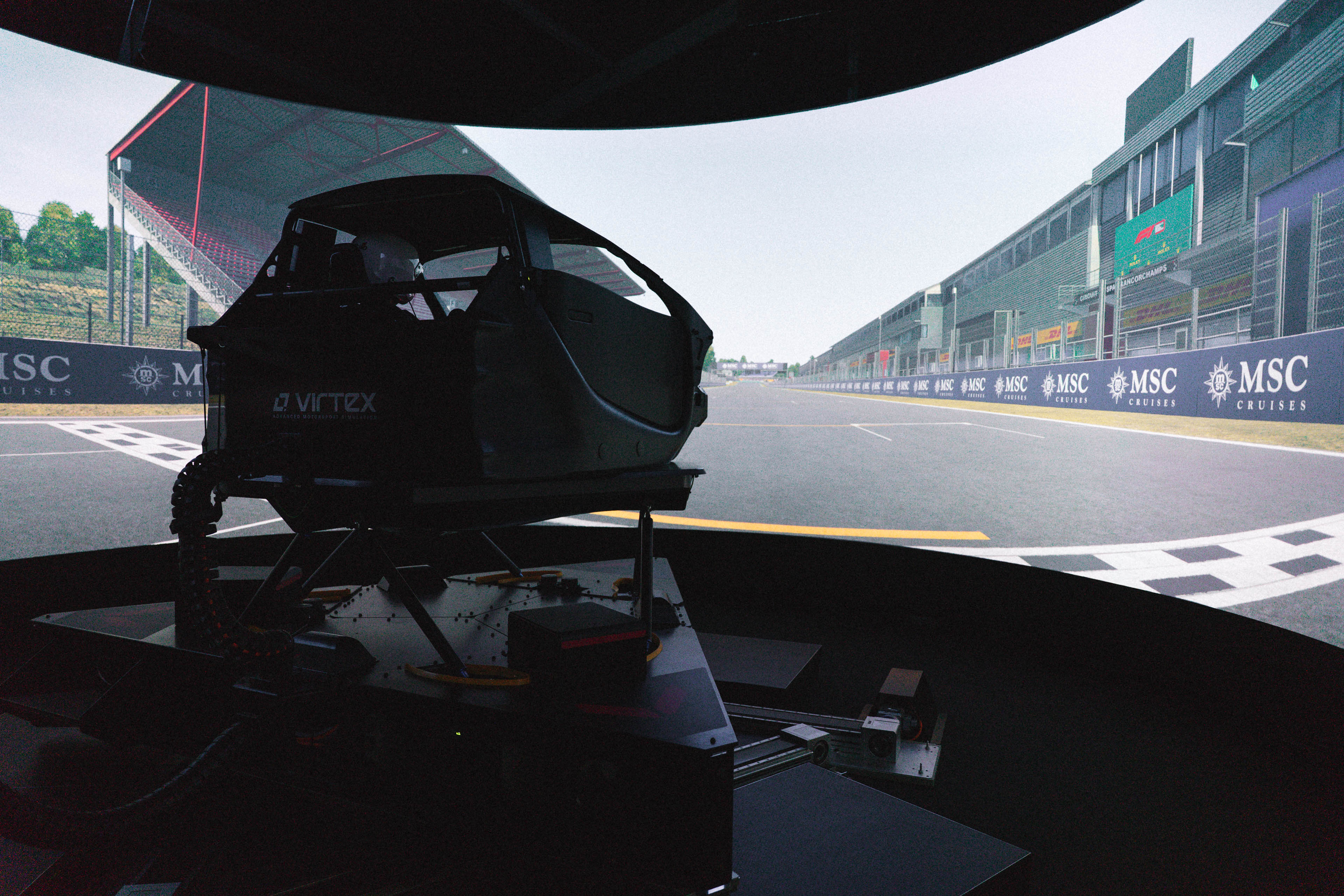
The Virtex GT cockpit is designed with this variability in mind. The seating position is fully adjustable. Brand-specific steering wheels can be integrated, with the corresponding display and switch configurations. Control system layouts are adapted per programme.
A particularly significant element for GT simulation is the brake system. GT cars run ABS, and drivers rely on the system's feedback through the pedal — the characteristic vibration that communicates ABS activation. The Virtex GT simulator uses a hydraulic active brake system that replicates both this ABS vibration and adjustable pedal stiffness. The driver's braking technique in the simulator is therefore formed under the same sensory conditions they will experience in the car.
The vehicle model for GT programmes includes accurate ABS and traction control emulation, custom-built for the specific car. ECU emulation and telemetry integration are also programme-specific. The GT3 graphics model is matched to the team's car.
GT suspension architectures also vary more widely than in single-seater categories. While Formula cars typically run double wishbone suspension with standardised geometry, GT cars may use double wishbone, MacPherson strut, or in some cases active suspension systems. Each configuration produces different load paths and different responses to setup changes. The vehicle model must reflect the correct topology for the specific car, not a generic GT approximation.
Prototypes: high complexity, high specificity
LMP programmes represent perhaps the most demanding configuration challenge. The cars are largely bespoke, with chassis and cockpit architectures that vary significantly between manufacturers and programmes. There is no standardised template to work from.
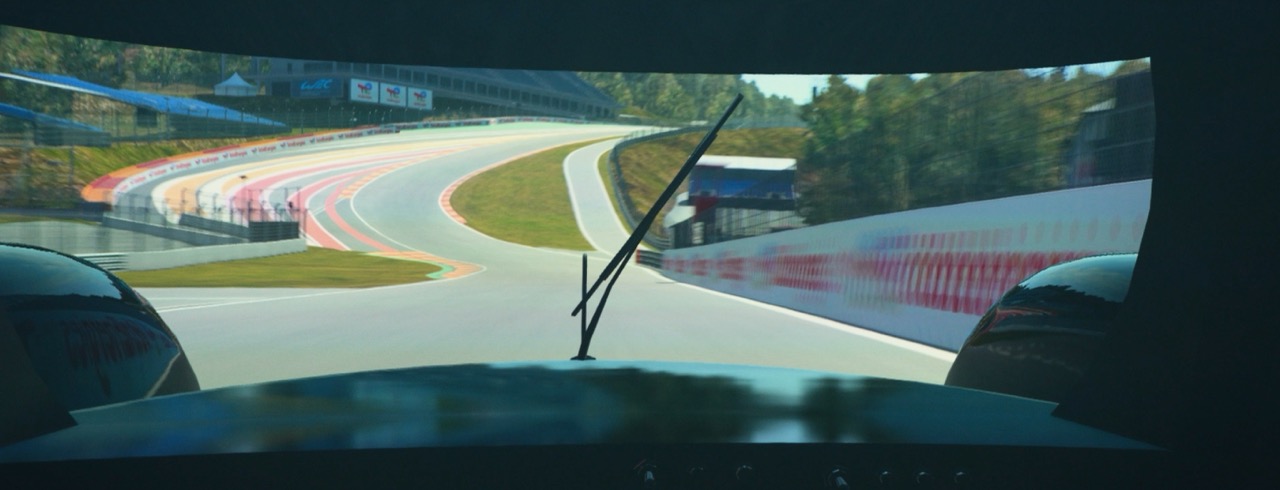
The Virtex LMP cockpit configuration follows the overall seating geometry and driving position of the prototype closely, with targeted adaptations to reflect the specific car's control layout and ergonomic requirements. Team-specific steering wheels are integrated. Control systems are configured to match the car. Telemetry output is structured to align with the team's own data analysis workflow.
The vehicle model for LMP work is built to a high level of fidelity, reflecting the aerodynamic complexity and powertrain architecture of the specific car. LMP prototypes are highly sensitive to aerodynamic platform behaviour — the relationship between ride height, downforce and balance is a central element of setup work. A model that does not correctly represent these relationships cannot support the aerodynamic development work that LMP teams typically bring to the simulator.
Given the bespoke nature of LMP programmes, the integration work required before a simulator session is more extensive than in a standardised series. Data gathering, model parameterisation and cockpit configuration are all carried out in close collaboration with the team's engineers. The result is a simulator environment specific to that programme, not a general prototype approximation.
Where we draw the line
Professional simulation requires judgement about what to replicate and what to simplify. Not every aspect of the real car needs to be reproduced in order to conduct effective engineering work. Identifying where the line sits is part of configuring a programme correctly.
One deliberate simplification is collision handling. Rather than attempting to simulate physical contact — which would be disruptive, potentially uncomfortable, and of limited engineering value — the simulator records contact events without generating an impact response for the driver. This keeps sessions productive and focused.
Another concerns vehicle model configuration for specific session objectives. No single model setup is optimal for every type of simulator work. A session focused on setup exploration requires a different configuration from one focused on driver familiarisation or tyre understanding. For example, a hot-lap familiarisation session may call for tyres pre-conditioned to the correct operating temperature, so the driver immediately experiences representative grip levels rather than spending laps in unrepresentative cold-tyre conditions.
These are deliberate choices, made in advance of each session in consultation with the team.
The underlying principle is that fidelity is in service of engineering objectives, not an end in itself. Every configuration decision should be traceable to a specific requirement of the programme.
The integration of hardware, model and track
Across all three categories, a principle that holds without exception is that hardware quality alone cannot compensate for a low-fidelity vehicle model. The most precisely configured cockpit is of limited value if the vehicle model does not correctly represent how the car responds to setup changes or driver inputs.
Equally, a high-fidelity vehicle model is degraded by inaccurate track representation. At Virtex, track models are built from LiDAR scan data, capturing the surface geometry, kerb profiles and camber variations of the circuit with sufficient precision to reproduce the vehicle-track interaction the driver will experience at the real venue. This closes the loop between vehicle model, cockpit and environment.
The simulation infrastructure itself runs on a hard real-time system. This means the vehicle model remains continuously synchronised with the hardware — steering, brakes, motion platform — without the jitter or latency that softer real-time architectures can introduce. At the level of precision that professional drivers operate, those artefacts are detectable and damaging to the quality of driver feedback.
Vehicle models are also updated and refined after each simulator session. Driver feedback is compared against telemetry data. Discrepancies are investigated and parameters adjusted. Over time, the model converges more closely with the real car. This iterative process is not a one-time exercise but a continuous part of how a professional simulator programme is managed.
Different cars, the same standard
The diversity of professional motorsport categories means that no single simulator configuration serves all programmes equally well. A GT team and a single-seater team have different cockpit requirements, different vehicle architectures, different driver aid systems and different engineering priorities.
What does not change across categories is the standard against which each configuration is measured: the simulator must behave as an extension of the real car. The driver should be able to move between the simulator and the circuit without meaningful re-adaptation. Engineering conclusions reached in the simulator should transfer to the track.
Meeting that standard in a Formula car, a GT3 car and an LMP prototype requires different solutions. The engineering commitment behind each of them is the same.

Thank you!
Your submission has been received!

Virtex and AIX Racing Enter Technical Collaboration
News
From Digital Twin to Engineering Tool: Turning Simulation into Structured Decision-Making

Tech
Why Lap Time Is Not Enough: The Physics Behind a Professional Vehicle Model

Tech
Why Cockpit Fidelity Is a Performance Variable, Not an Aesthetic Choice
Tech
VIRTEX and CURBSTONE Partner to Bridge the Gap Between Virtual and Real-World Testing
News
From Sim to Pole: The Impact of Virtex in Action
Tech
Purpose over Perfection: How Virtex Approaches Simulation
Inside Virtex
What Makes Virtex’s Simulator Unique
Tech
AI and the Future of Race Preparation
Tech
Behind the Tech: A Day in the Life of Virtex’s CTO
Inside Virtex
Engineering Precision: How We Fine-Tune the Virtex Simulator
Tech
A Day in the Life of a Simulator Engineer
Inside Virtex
Track Time Is Limited. Simulation Isn’t.
Tech
Partners in Precision: Dynisma, Spa-Francorchamps, and Us
Inside Virtex
Is Relying Solely on Track Testing Still the Best Option?
Tech
How Can Sim Time Beat Track Time?
Tech
How Simulation Technology is Redefining Driver Development
Tech
VIRTEX OFFICIALLY LAUNCHES F1-GRADE SIMULATION CENTRE TRACKSIDE AT SPA- FRANCORCHAMPS
News