Tech
Why Cockpit Fidelity Is a Performance Variable, Not an Aesthetic Choice
When discussing professional vehicle simulation, attention naturally gravitates towards the visible technical pillars: tyre models, suspension kinematics, aerodynamic sensitivity, powertrain behaviour. These elements are, quite rightly, central to any credible vehicle model.
However, before any of that physics becomes meaningful, there is a more fundamental layer to consider: the driver’s physical interface with the car.
At Virtex, cockpit fidelity is not treated as a presentation. It is considered part of the vehicle system itself.

As Barney Hassell, Head of Vehicle Dynamics, explains:
“The driver’s perception of what the car is doing is intrinsically linked to their seating position and the visibility they have from that position. Their feedback and ability to control the car are further influenced by the positioning and ergonomics of the controls, such as the throttle, brake pedal and steering wheel. These factors apply equally to real cars and simulators.”
This is not simply a question of comfort. It is a question of system integrity. A racing driver operates within a closed-loop control system in which perception, interpretation and physical input are continuously interacting with vehicle response. Alter the interface and the behaviour of that system changes.
Adaptation is not neutral
Professional drivers are highly adaptable. They can adjust rapidly to new machinery and environments. Yet adaptation carries a cost.
"Although race drivers tend to be very adaptable,” Barney notes, “a significant change in cockpit configuration would require them to re-adapt their driving. In that sense, the car would no longer be the same."
If the seating position shifts, if pedal stiffness differs from the real car, or if steering wheel geometry changes, the driver compensates. Those compensations may be subtle, but they influence braking modulation, steering rate, reference points and muscle memory. Lap time may appear broadly similar, but the mechanism producing it has changed.
For a professional engineering programme, that distinction matters. The objective of simulation is not to produce plausible outputs, but to preserve transferability. Any adaptation layer introduced by an inaccurate cockpit reduces confidence that work completed in the simulator will translate directly to track performance.
Recreating the physical reference frame
For that reason, Virtex approaches cockpit configuration as part of the modelling process itself.
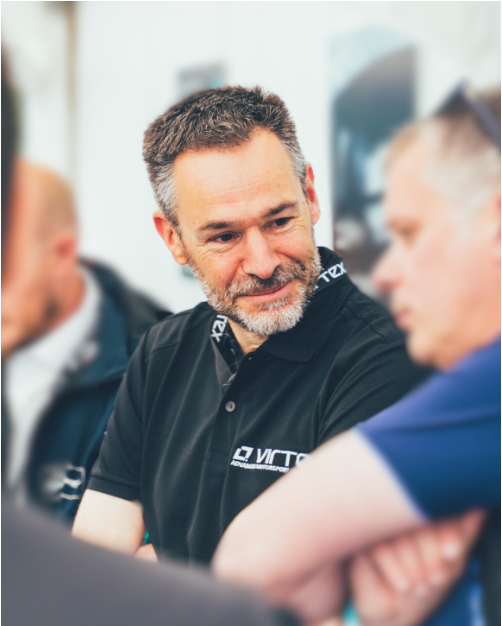
"For maximum effectiveness of a simulator programme,” Barney explains, “we aim to recreate the real car as faithfully as possible in the simulator environment, in order to minimise any driver adaptation requirements and ensure that results in simulation directly translate to results in the real car."
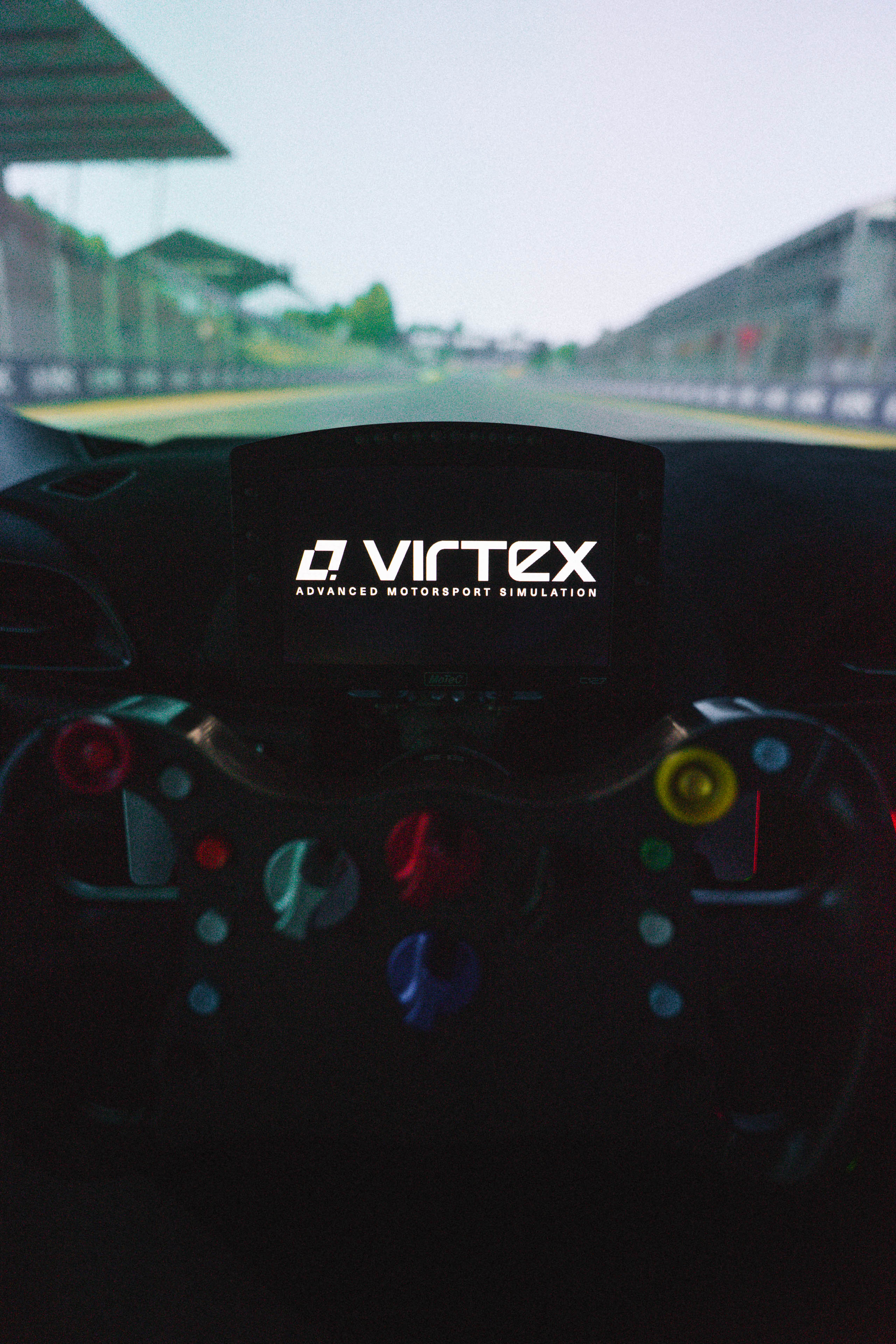
In practical terms, this often means placing the driver in the correct spatial reference frame relative to the vehicle model. Where possible, the same seat insert used in the real car can be installed in the simulator. Pedal positions are matched geometrically, but also mechanically, including travel and stiffness characteristics. Steering wheel placement and orientation are aligned to replicate the real driving posture.
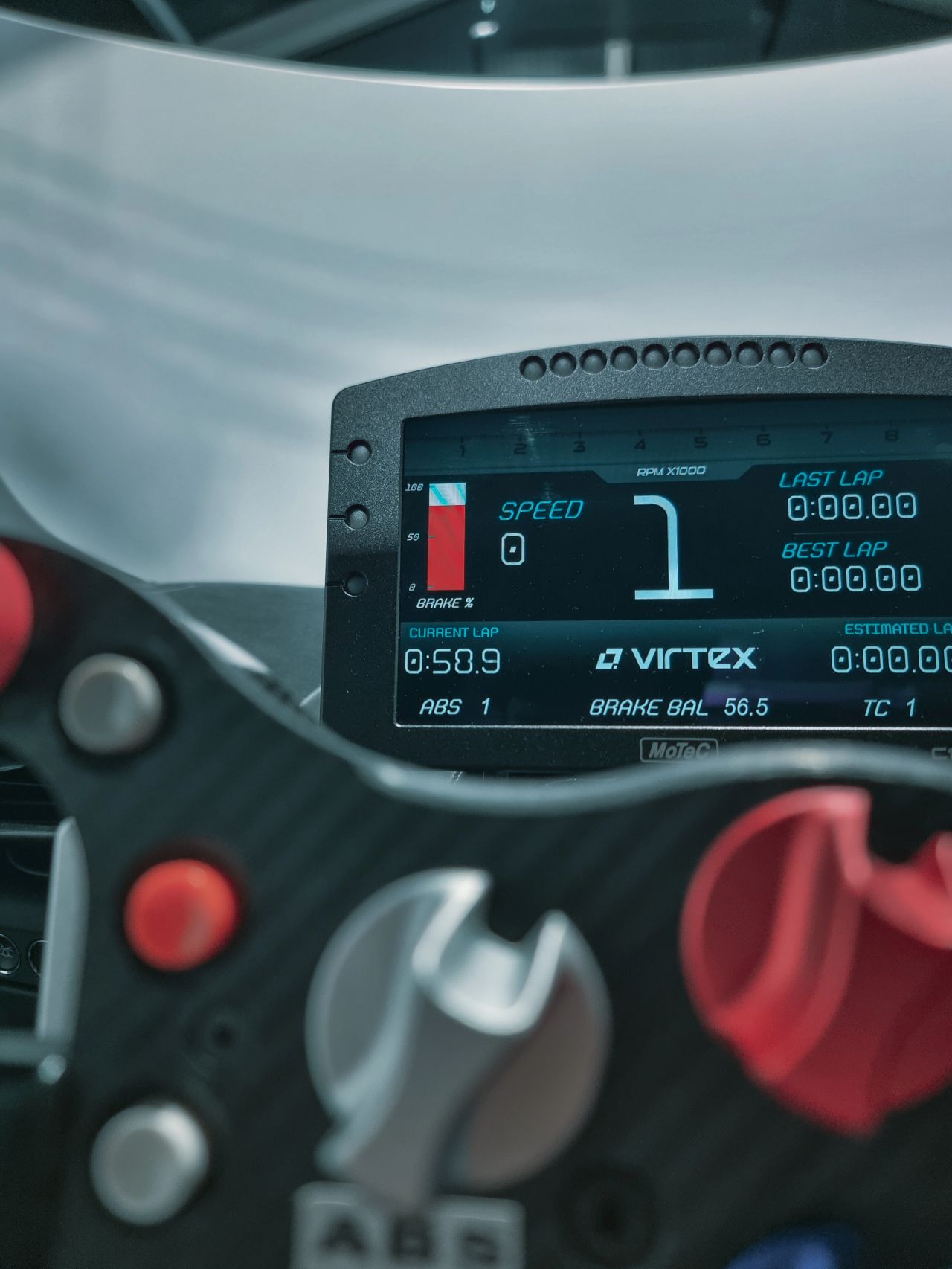
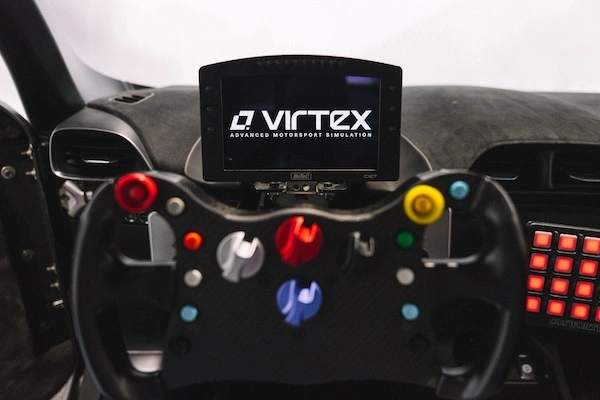
Ancillary systems such as dash displays, rotary switches and brake bias controls can also be reproduced. While these elements may not always sit directly within the driver’s continuous control loop, maintaining familiarity reduces cognitive load and supports performance consistency over long sessions.
The objective is behavioural continuity rather than visual resemblance.
Ergonomics as part of vehicle dynamics
From a modelling perspective, it may be tempting to treat ergonomics as external to vehicle dynamics. In reality, the driver is part of the dynamic system. Their physical interaction with the controls influences effective control gains and input bandwidth.
A small variation in pedal stiffness can alter brake modulation sensitivity. A shift in seating position changes steering torque perception. Differences in steering wheel offset modify arm leverage and influence steering rate control. Each effect is subtle in isolation, but professional drivers operate precisely within this range of subtlety.
When simulation is used for setup optimisation, tyre understanding, aerodynamic balance studies or correlation work, even small behavioural deviations introduce noise into the engineering process. By replicating cockpit geometry and mechanical characteristics accurately, that noise is reduced and the fidelity of conclusions improves.
Programme-dependent fidelity
Importantly, cockpit fidelity is not approached dogmatically.
"We do not necessarily draw a line anywhere,” Barney says. “We work with our customer to identify the best customisation for the requirements of their programme."
A single-seater team preparing for race weekend correlation work may require extremely precise replication of seating position and pedal feel. A GT development programme may prioritise different elements depending on its objectives. The level of customisation is therefore aligned with engineering intent rather than dictated by a fixed template.
What remains constant is the principle that the simulator must behave as an extension of the real car.
More than a physical enclosure
There is a persistent tendency to view simulator cockpits as physical enclosures surrounding screens and motion systems. In professional motorsport, that interpretation is incomplete.
If the vehicle model represents a digital twin of the real car, then the cockpit is the interface that allows the driver to interact with that twin in a consistent and controlled manner. Without that interface accuracy, even the most sophisticated physics model can be undermined by adaptation effects. With it, simulation becomes a reliable engineering environment in which changes made virtually can be expected to translate to performance on track.
For teams operating at the highest level, that reliability is not a luxury. It is a prerequisite.

Thank you!
Your submission has been received!

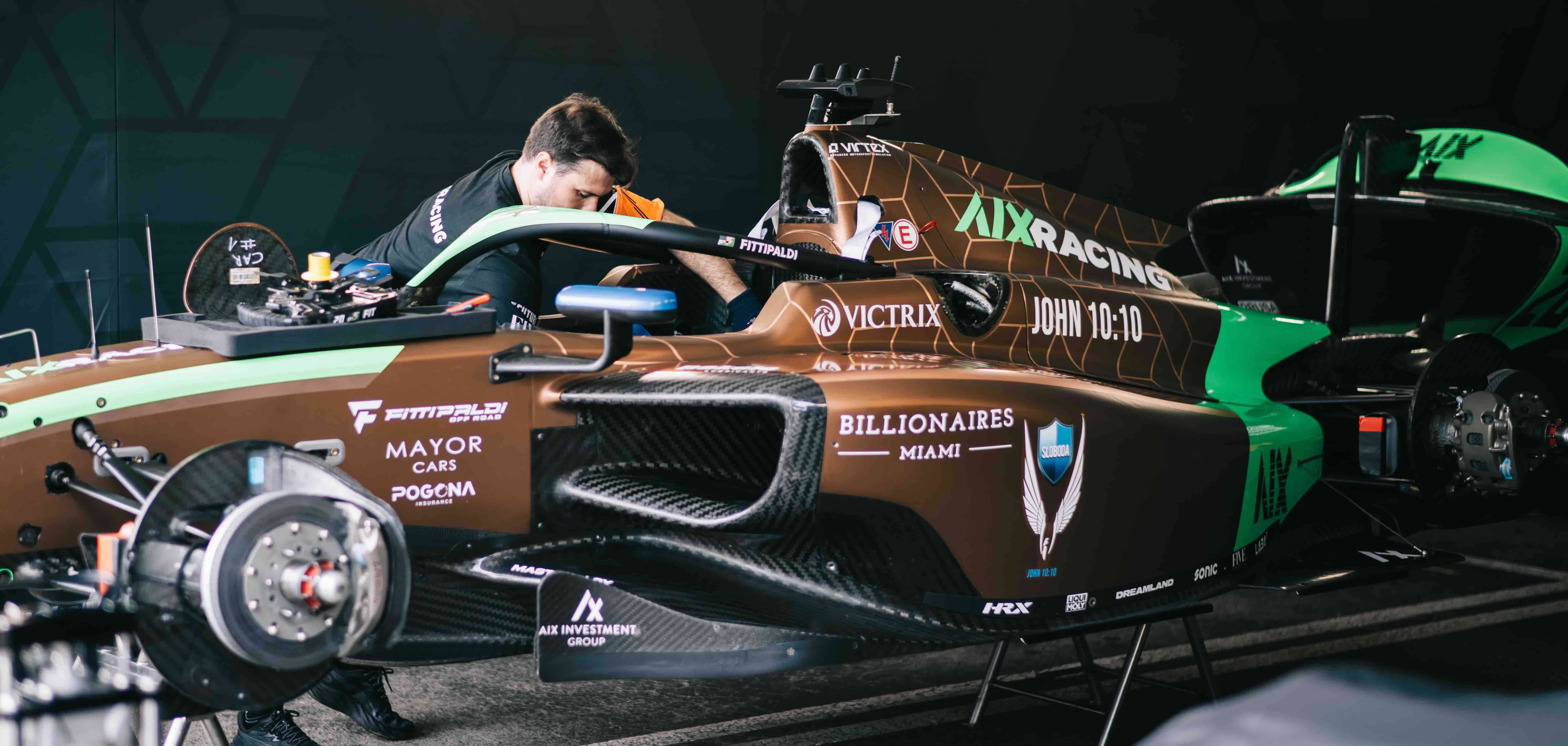
Virtex and AIX Racing Enter Technical Collaboration
News
From Digital Twin to Engineering Tool: Turning Simulation into Structured Decision-Making

Tech
One Simulator, Three Cars: How Cockpit Configuration Changes Across Categories

Tech
Why Lap Time Is Not Enough: The Physics Behind a Professional Vehicle Model

Tech
VIRTEX and CURBSTONE Partner to Bridge the Gap Between Virtual and Real-World Testing
News
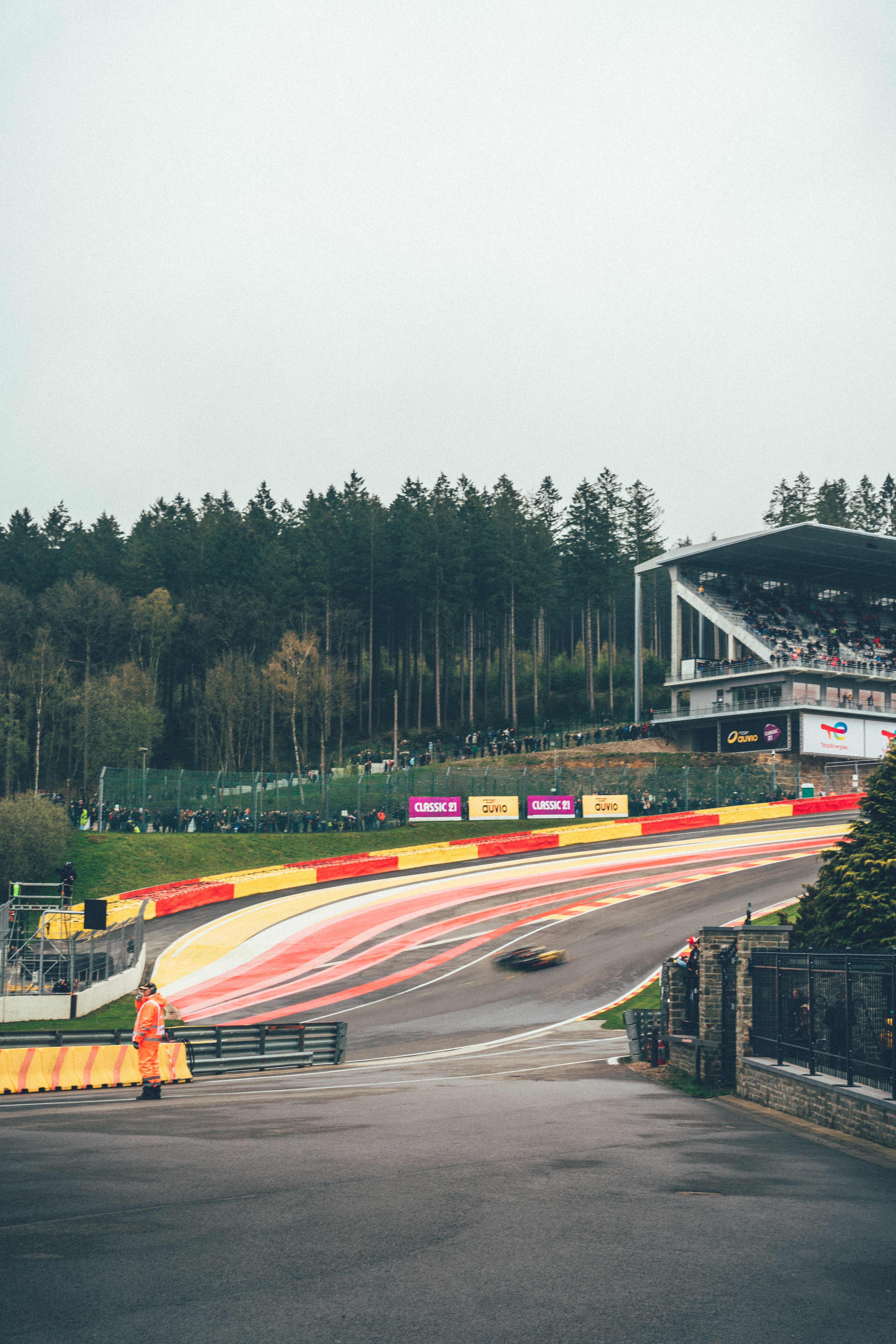
From Sim to Pole: The Impact of Virtex in Action
Tech
Purpose over Perfection: How Virtex Approaches Simulation
Inside Virtex
What Makes Virtex’s Simulator Unique
Tech
AI and the Future of Race Preparation
Tech
Behind the Tech: A Day in the Life of Virtex’s CTO
Inside Virtex
Engineering Precision: How We Fine-Tune the Virtex Simulator
Tech
A Day in the Life of a Simulator Engineer
Inside Virtex
Track Time Is Limited. Simulation Isn’t.
Tech
Partners in Precision: Dynisma, Spa-Francorchamps, and Us
Inside Virtex
Is Relying Solely on Track Testing Still the Best Option?
Tech
How Can Sim Time Beat Track Time?
Tech
How Simulation Technology is Redefining Driver Development
Tech
VIRTEX OFFICIALLY LAUNCHES F1-GRADE SIMULATION CENTRE TRACKSIDE AT SPA- FRANCORCHAMPS
News